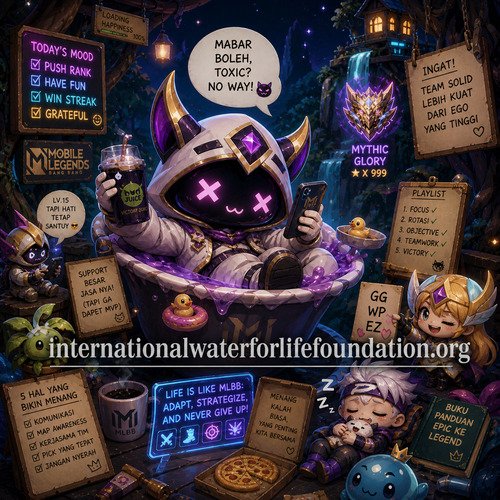
internationalwaterforlifefoundation.org – Mobile Legends: Bang Bang is one of the most successful mobile games in the world, especially within the competitive gaming scene. The title has grown far beyond being just a casual pastime. It has become a major esport, attracting professional players, streamers, and millions of everyday users who log in to compete in ranked matches. Its popularity continues because it offers a mix of action, strategy, and teamwork that keeps every match exciting.
For new players, the game can feel approachable because the controls are simple. Movement is handled through a virtual joystick, while abilities are activated with buttons placed around the screen. This design makes it easy for anyone to start playing quickly. However, beneath those simple controls lies a highly strategic system. Winning requires far more than mechanical skill. Players must understand timing, map awareness, hero selection, and teamwork to consistently perform well.
One reason Mobile Legends remains so engaging is that no match unfolds exactly the same way. Even when players choose familiar heroes, different teammates and opponents create new situations. This constant variation means players must think critically and adapt during every game.
Understanding the Essential Mechanics of the Game
The most important concept in Mobile Legends is that the match is won by destroying the enemy’s base crystal. While combat is central to the gameplay, eliminations are not the ultimate objective.
The battlefield has three lanes connecting both teams’ bases. Each lane is protected by several defensive turrets. These structures must be destroyed to create a path to the enemy core.
Many beginners focus too much on defeating enemy heroes. While kills can provide temporary advantages, they only matter if the team uses that opportunity to take objectives. A successful team fight should lead to pushing a lane, taking a turret, or securing an objective such as Turtle or Lord.
This understanding changes how players approach the game. Instead of chasing opponents for personal glory, experienced players think about how every fight contributes to overall map control.
Hero Roles and Their Strategic Importance
Every hero in Mobile Legends belongs to a role that defines how they function in the team. These roles include Tank, Fighter, Assassin, Mage, Marksman, and Support.
Tanks are durable heroes who protect allies and initiate fights. Fighters are balanced between offense and defense, making them flexible in many situations. Assassins are fast and specialize in eliminating vulnerable enemies quickly.
Mages provide magical damage and often influence fights through crowd control. Marksmen deliver consistent ranged damage and usually become the strongest late-game damage dealers. Supports enhance allies through healing, shielding, or other helpful abilities.
A balanced team composition is critical. If a team lacks a frontline, its damage dealers may be easily eliminated. If it lacks a marksman, it may struggle to finish objectives in the late game.
Understanding roles also helps players predict enemy behavior. Knowing which hero is likely to flank or initiate allows for better positioning.
Farming and Building Strength
Farming is one of the most fundamental aspects of Mobile Legends. It refers to collecting gold and experience from minions, jungle monsters, and objectives.
Gold is used to purchase items that strengthen heroes. Experience increases hero levels and unlocks stronger abilities. A player who farms efficiently gains these advantages faster than opponents.
This creates a power difference that often decides fights. Even a highly skilled player can struggle if they fall behind in farm.
The jungle is especially important because it provides buffs. Red buff increases offensive pressure, while blue buff supports heroes who rely on mana and cooldown reduction.
Players who consistently farm well often have a major advantage regardless of how many kills they secure.
Playing Through Each Phase of a Match
The early game is where players establish their initial advantage. During this phase, farming and lane control are the highest priorities.
Lane players should focus on clearing minion waves while avoiding risky positions. Extending too far can result in being ambushed by the enemy jungler.
Junglers need to secure buffs, clear camps efficiently, and rotate to help teammates. A successful early gank can create a strong advantage for the entire team.
The first Turtle is often the most important objective. Securing it grants bonus gold, which accelerates item progression for the whole team.
A strong early game is usually built on consistency rather than reckless aggression.
Mid Game: Rotations and Pressure
The mid game begins when players have acquired several items and outer turrets start falling. This phase is defined by movement across the map.
Rotations allow players to support allies, contest objectives, and pressure multiple lanes. Mid-lane players often lead these rotations because of their central position.
Teams that perform well in the mid game usually focus on destroying turrets and invading the enemy jungle. This reduces enemy resources and increases control.
Lord becomes an important objective during this phase. Securing it can create strong lane pressure and open the path to victory.
The mid game rewards players who monitor the minimap and react quickly to enemy movements.
Late Game: The Final Challenge
The late game is the most decisive phase. Heroes are close to full build, and team fights become extremely impactful.
Death timers are long enough that losing one major fight can end the match. Because of this, players must be cautious.
Marksmen and mages become the primary damage sources. Tanks must protect them and create space. Assassins should wait patiently for the right moment to attack.
The Lord often becomes the deciding factor. A team that secures Lord while winning a team fight usually has a clear path to the enemy base.
Patience and discipline are especially valuable during this stage.
Specialize in a Few Heroes
Trying to learn every hero at once often slows improvement. Focusing on a small hero pool allows deeper understanding.
Players can learn skill timing, ideal item builds, and matchups more effectively when they specialize. This leads to more consistent results. After mastering several heroes, branching into additional roles becomes easier.
Learn From Losses
Defeat can be one of the best learning tools. Players should reflect on what went wrong instead of only blaming teammates.
Did they farm poorly? Did they ignore objectives? Did they overextend? Identifying mistakes helps create better habits.
This process is essential for long-term improvement.
Communicate and Coordinate
Mobile Legends is designed around teamwork. Even simple communication through pings can improve performance.
Players can warn teammates, signal objectives, or coordinate attacks. Teams that communicate effectively often outperform teams with stronger individual mechanics but poor coordination.
Trusting teammates and supporting them is a key part of success.
Conclusion Mobile Legends and the Skills Required to Play It Successfully
Mobile Legends: Bang Bang is much more than a mobile action game. It is a competitive strategy experience where decision-making, teamwork, and adaptability are essential.
To play effectively, players must understand objectives, hero roles, farming, and the different stages of the match. Success is rarely determined by individual skill alone. Instead, it comes from how well a team works together and makes strategic decisions.
Improvement requires patience and reflection. By focusing on a few heroes, learning from mistakes, and prioritizing teamwork, players can steadily become stronger.
What makes Mobile Legends truly compelling is the endless variation in every match. Each game presents new challenges, ensuring that players always have something new to learn and master.